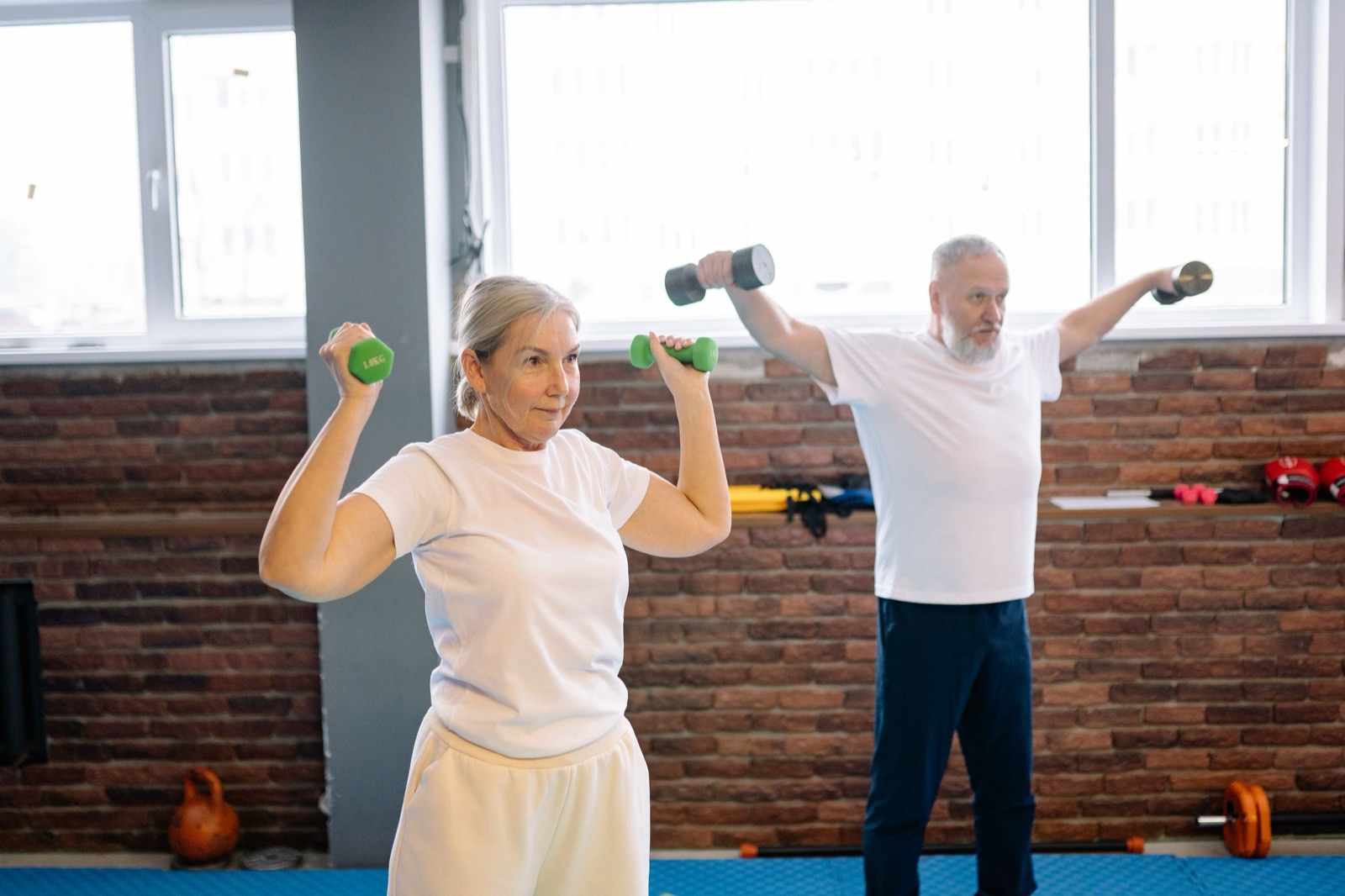
For some women, it looks that way. A study that followed women for 21 years found hs-CRP and IL-6 rose around the final period in women who started out low. But studies that compare women before and after menopause find no clear CRP gap. Exercise trials in postmenopausal women lowered these markers.
What do inflammation markers do at menopause?
Doctors track long-lasting inflammation with blood markers. CRP (C-reactive protein) rises when inflammation is up, and hs-CRP is a more sensitive test for it. IL-6 and TNF-α are signaling proteins that help drive inflammation.
The simplest way to study menopause is to compare two groups: women who still have periods and women who have stopped. A 2024 meta-analysis did exactly that. Postmenopausal women had more fat around the middle and higher levels of leptin and adiponectin, two hormones made by fat tissue. But their CRP and IL-6 were not clearly higher.
There is a problem with snapshots, though. The two groups differ in age, in weight and in the hundred small habits that pile up over a decade, so a real change that happens to one woman over a few years can hide inside the noise between thousands of different women. The authors rated the evidence low certainty and asked for studies that follow women through the change.
Is perimenopause a time when inflammation rises?
That is what the Study of Women's Health Across the Nation (SWAN) set out to see. It measured hs-CRP in 1,470 women and IL-6 in 779 women, up to 15 times over 21 years.
Women who entered menopause with low inflammation saw it rise from about a year before their last period to three years after.From a 2025 cohort in J Clin Endocrinol Metab
The women did not all move the same way. The researchers found three patterns for each marker. In the "Low-Rise" group (27.2% of women for hs-CRP, 36.0% for IL-6), levels climbed from as early as one year before the final period to as late as three years after. A middle group also rose for IL-6.
Women who started high mostly stayed high, or even dipped around the last period. Being overweight or obese went with those high patterns.
So the honest answer depends on where you start. If your markers were low going in, menopause may be when they creep up. The authors read their results as support for menopause adding to inflammation, separate from age.
Why would menopause raise inflammation?
Body fat is the leading suspect. In a 5-year Canadian study of 58 healthy women moving through menopause, several inflammation markers went up, including IL-8 and two TNF-α receptors. Oddly, hs-CRP went down over the five years.
Still, the changes tracked the body. Women whose waist grew more tended to see a bigger rise in hs-CRP. Changes in fat mass explained 15% of the change in IL-8. Women who became less active saw two other blood markers rise.
Sleep may play a part too. In 295 women aged 40 to 60, wrist trackers measured how much of their time in bed was spent asleep. Women who slept less of that time had higher IL-6, even after the researchers accounted for weight and activity. That study is a snapshot, so it shows a link, not a cause.
Can exercise lower inflammation after menopause?
This is where the evidence is strongest. A 2021 meta-analysis pooled 32 studies with 1,510 postmenopausal women. Exercise training lowered IL-6, TNF-α and CRP compared with no training. Aerobic, strength and mixed programs all worked, in women under 64 and in women 64 and older.
Women carrying extra weight saw the same pattern. In 34 trials with 2,229 postmenopausal women with overweight or obesity, exercise lowered CRP, TNF-α and IL-6.
A 2026 review of 30 randomized trials with 2,124 women added a twist. Exercise lowered CRP and TNF-α, but the change in IL-6 was not clear. More total minutes did not mean a bigger drop. Harder effort showed a trend toward a bigger TNF-α drop, but it fell just short of clear proof.
Strength training on its own lowered CRP in 12 trials with 482 women. The reviewers rated that evidence very low certainty, so treat it as a promising sign.
Does food make a difference?
The diet evidence aimed at this group is thinner. The clearest trials are on soy. Across 24 randomized trials in postmenopausal women, soy lowered CRP by 0.11 mg/L. Whole soy foods did better, at 0.23 mg/L, which the authors put at about a 9% drop. Soy did not change IL-6 or TNF-α.
What this means for you
Tick what you'll try this week. Your picks stay on this device.
you have joint swelling, redness or morning stiffness, have heart disease or chest pain with effort, have had a hormone-sensitive cancer, or are weighing hormone therapy for your symptoms.
One tap. Results appear once 50 readers have voted, and the count is always real.
The bottom line
Pooled snapshots found no clear CRP gap. The long study found a rise, but mostly in women who started low. A growing waist and poor sleep tagged along with higher markers. Menopause does not flip a switch for everyone. It may nudge inflammation up, mostly for women who start low, and the habits that push back are the plain ones. Move, add some effort, sleep, and put soy on the plate.
Common questions
Is perimenopause inflammatory?
It can be. In the SWAN study, women who started with low hs-CRP and IL-6 saw rises from about one year before the final period, which falls in late perimenopause. The rises lasted until about three years after. Women who started with high levels did not show the same climb. So perimenopause seems to matter most for women whose markers were low going in.
Does menopause cause inflammation in joints?
Joint pain and arthritis are more common in women, and they grow more common with age. For some women, they seem to start around menopause. A 2018 review called that link strong. But it found no proof that falling estrogen causes joint pain or arthritis, and few studies have looked at it closely. New joint pain is worth a doctor's visit.
Is there an anti-inflammatory diet for menopause?
No single menopause diet has been tested for inflammation in our sources. Soy is the best-studied food. In 24 trials in postmenopausal women, soy lowered CRP a little, and whole soy foods lowered it by about 9%. Soy did not move IL-6 or TNF-α. For the bigger drops, the trials point to exercise.
Does hormone therapy lower inflammation?
It depends on the type. A 2025 review of 13 trials with 2,278 women studied one common hormone pill combination. It lowered CRP and fibrinogen, another blood marker, but not IL-6. The authors note that effects of hormone therapy on inflammation are still debated, and the results may not apply to other types. Hormone therapy is a choice to make with your doctor.
Ask the Research Desk
Heard something about inflammation you want checked? The best questions become articles, credited by first name only if you say yes.
How this article was made
Researched and written from 11 peer-reviewed papers. Our automated check matched every claim against the exact words of its source, confirmed every paper exists in PubMed, and found none retracted. Checked October 31, 2026. Not individually reviewed by a doctor. Photos are illustrative; the people in them are not patients or readers.
Grades run Strong, Moderate, Emerging, Early and Not supported, and the grade decides the words we may use. How we grade evidence · Medical disclaimer
Sources
- Meta-analysisA systematic review and meta-analysis investigating differences in chronic inflammation and adiposity before and after menopause.Pernoud LE, Gardiner PA, Fraser SD et al. Maturitas, 2024.PubMedFull paper
- CohortThe Relation Between Systemic Inflammation and the Menopause Transition: The Study of Women's Health Across the Nation.El Khoudary SR, Chen X, Qi M et al. J Clin Endocrinol Metab, 2025.PubMedFull paper
- CohortEffect of the menopausal transition and physical activity energy expenditure on inflammatory markers: a MONET group study.Razmjou S, Bastard JP, Doucet E et al. Menopause, 2016.PubMedFull paper
- Meta-analysisThe impact of exercise training on inflammatory markers in postmenopausal women: A systemic review and meta-analysis.Khalafi M, Malandish A, Rosenkranz SK Exp Gerontol, 2021.PubMedFull paper
- Meta-analysisEffect of exercise on inflammatory markers in postmenopausal women with overweight and obesity: A systematic review and meta-analysis.Tan L, Yan W, Yang W et al. Exp Gerontol, 2023.PubMedFull paper
- Meta-analysisThe effects of oral medroxyprogesterone acetate combined with conjugated equine estrogens on inflammation in postmenopausal women: a systematic review and meta-analysis of randomized controlled trials.Qiu J, He Y, Li J et al. Front Endocrinol (Lausanne), 2025.PubMedFull paper
- Meta-analysisEffects of exercise intensity and volume on systemic inflammation in overweight and obese postmenopausal women: a dose-response meta-analysis.Huang G, Wang G, Zhu L et al. Front Immunol, 2026.PubMedFull paper
- Meta-analysisEffects of resistance training on C-reactive protein in menopausal and postmenopausal women: a systematic review and meta-analysis of randomized controlled trials.Loaiza-Betancur AF, Gómez-Tomás C, Blasco JM et al. Menopause, 2022.PubMedFull paper
- Meta-analysisA Meta-Analysis of Randomized Controlled Trials of the Effects of Soy Intake on Inflammatory Markers in Postmenopausal Women.Bajerska J, Łagowska K, Mori M et al. J Nutr, 2022.PubMedFull paper
- Cross-sectionalSleep characteristics and inflammatory biomarkers among midlife women.Nowakowski S, Matthews KA, von Känel R et al. Sleep, 2018.PubMedFull paper